
戸村陽特任研究員、木内俊克特任准教授、村本真准教授、また本学学生の水谷泰平、松嶋航生による論文「Structurally Informed Kerf-Bending for Timber」が、ACADIA2025においてBest Paper Runner Upを受賞しました。
ACADIA(Association for Computer Aided Design in Architecture)は、建築分野におけるコンピュテーショナルデザインの研究と実践を推進する主要な国際学会で、1981年の設立以来、北米を中心に毎年カンファレンスを開催しています。
本論文では、木材のカーフベンディングにおいて、曲げ加工時に生じる引張応力分布の解析から破断リスクの高い領域を特定し、さらに3Dスキャンで取得した幾何情報にもとづいて欠損部や既存仕口を避けつつ最適なカーフ配置を導く設計・製作手法を提案しています。これにより、非標準材や古材のように形状の不均一性や欠損を含む木材に対しても、構造的安全性と形状精度を両立する製作プロセスを実現しています。
Regeneration and Extension of Traditional Japanese Post-and-Beam Construction
戸村陽*1[京都工芸繊維大学 KYOTO Design Lab 特任研究員]
木内俊克*1[京都工芸繊維大学 未来デザイン・工学機構 特任准教授]
村本真*2[京都工芸繊維大学 デザイン・建築学系 准教授]
水谷泰平[京都工芸繊維大学大学院在籍]
松嶋航生[京都工芸繊維大学大学院在籍]
*1 First Authorship *2 Senior Authorship
概要
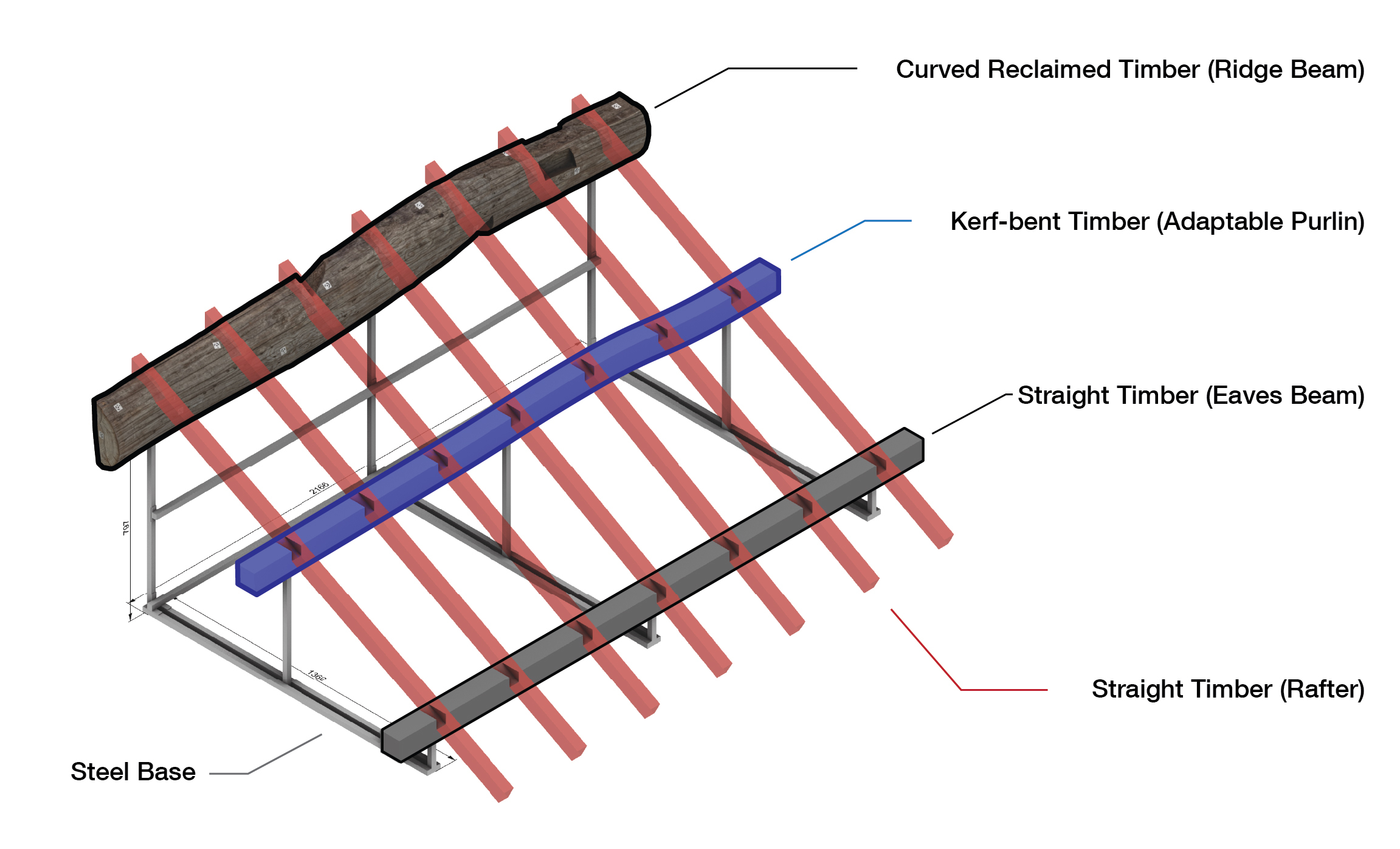
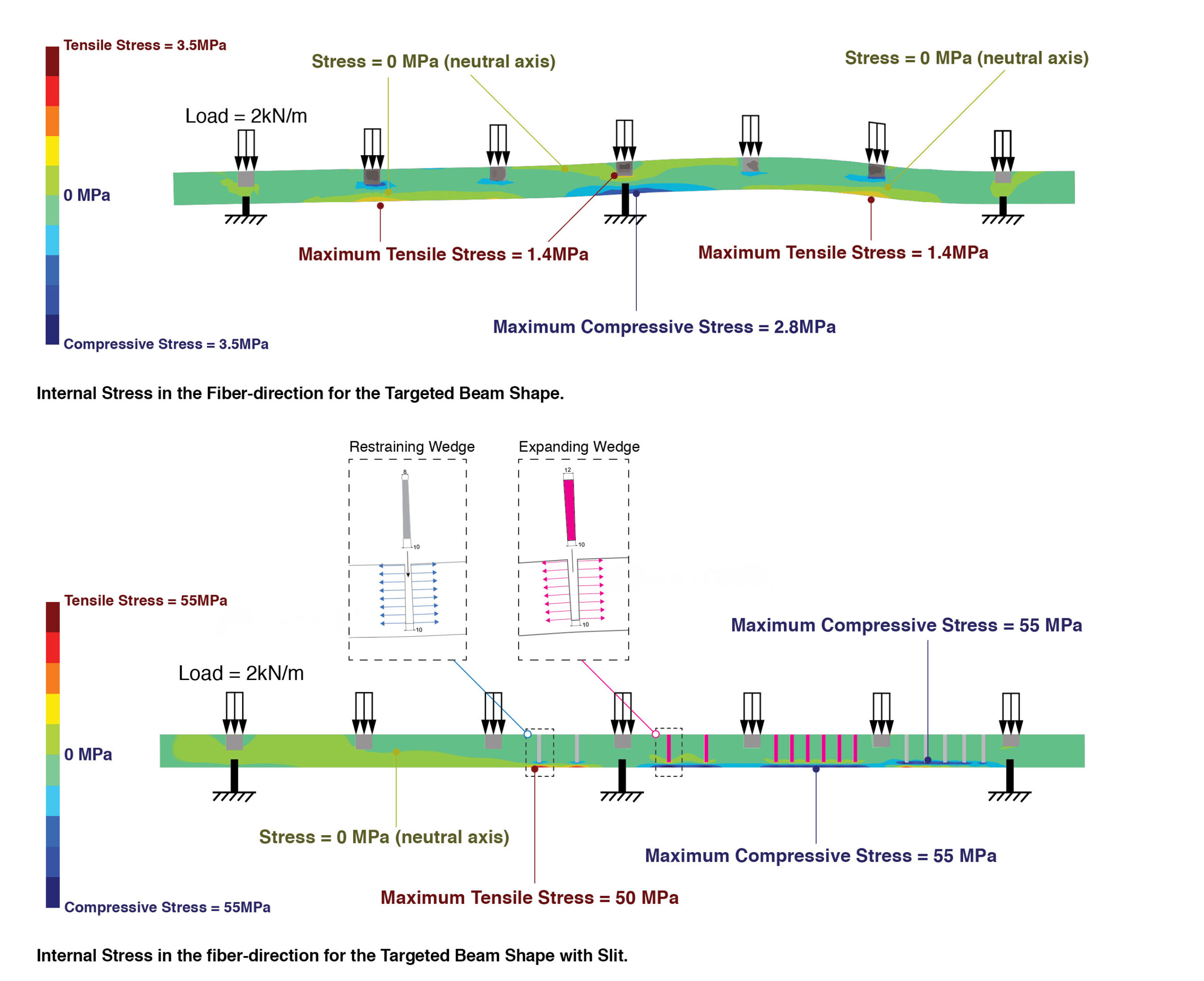
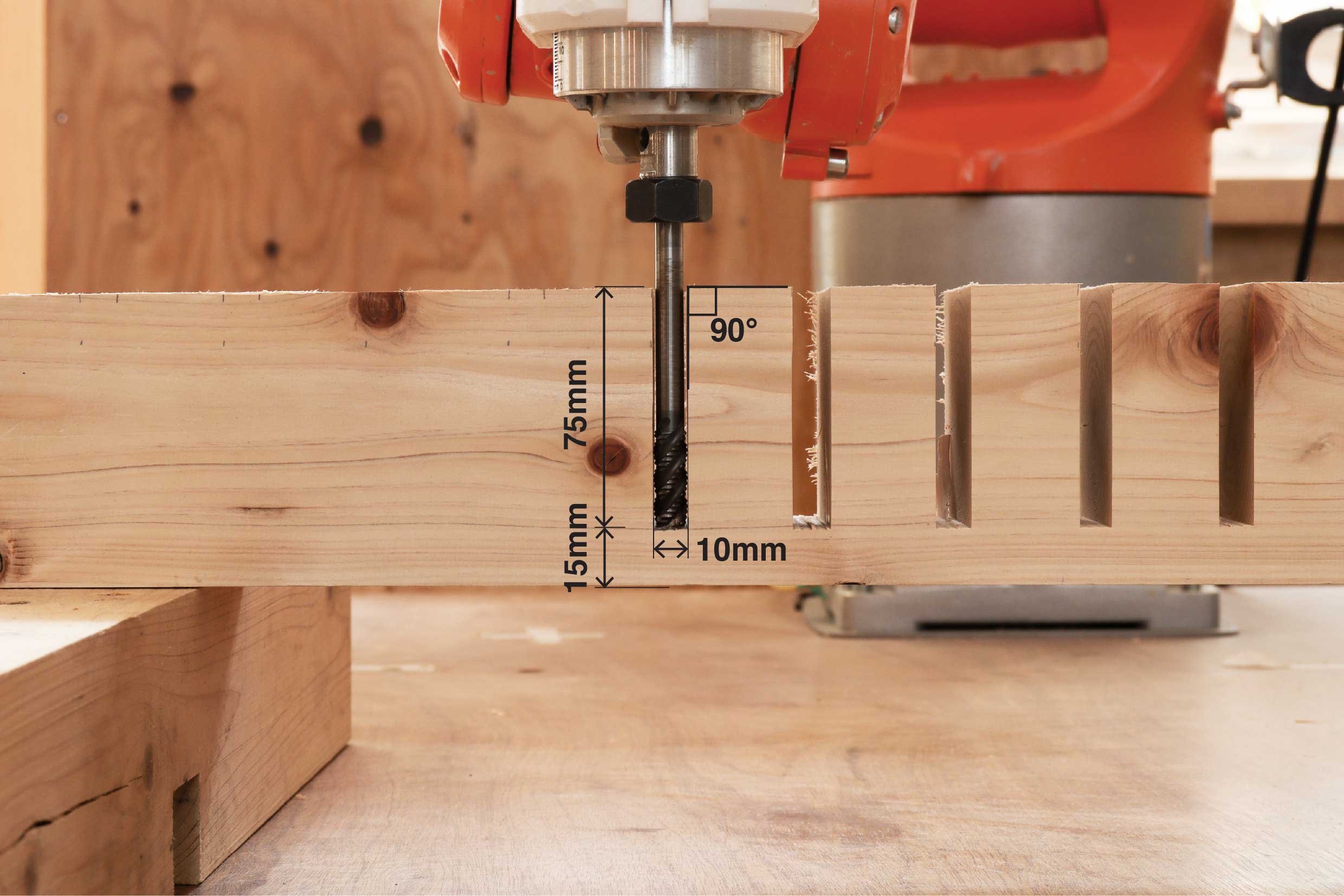
本稿では、湾曲を含む古材や天然木に代表される不定形木材の利活用促進を目的に、それら不定形木材と製材された新材を同等に取り扱い架構として組み上げる為、適宜必要な形状調整を、構造性能を担保した曲げ加工により実現する設計・製作手法を提案する。具体的には、カーフベンド加工によって木材にスリットを入れて曲げを実現する際に、有限要素法(FEM)解析を併用することで、切り込みによる強度低下を最小限に抑えつつ目標形状を精度よく得られるように設計する。
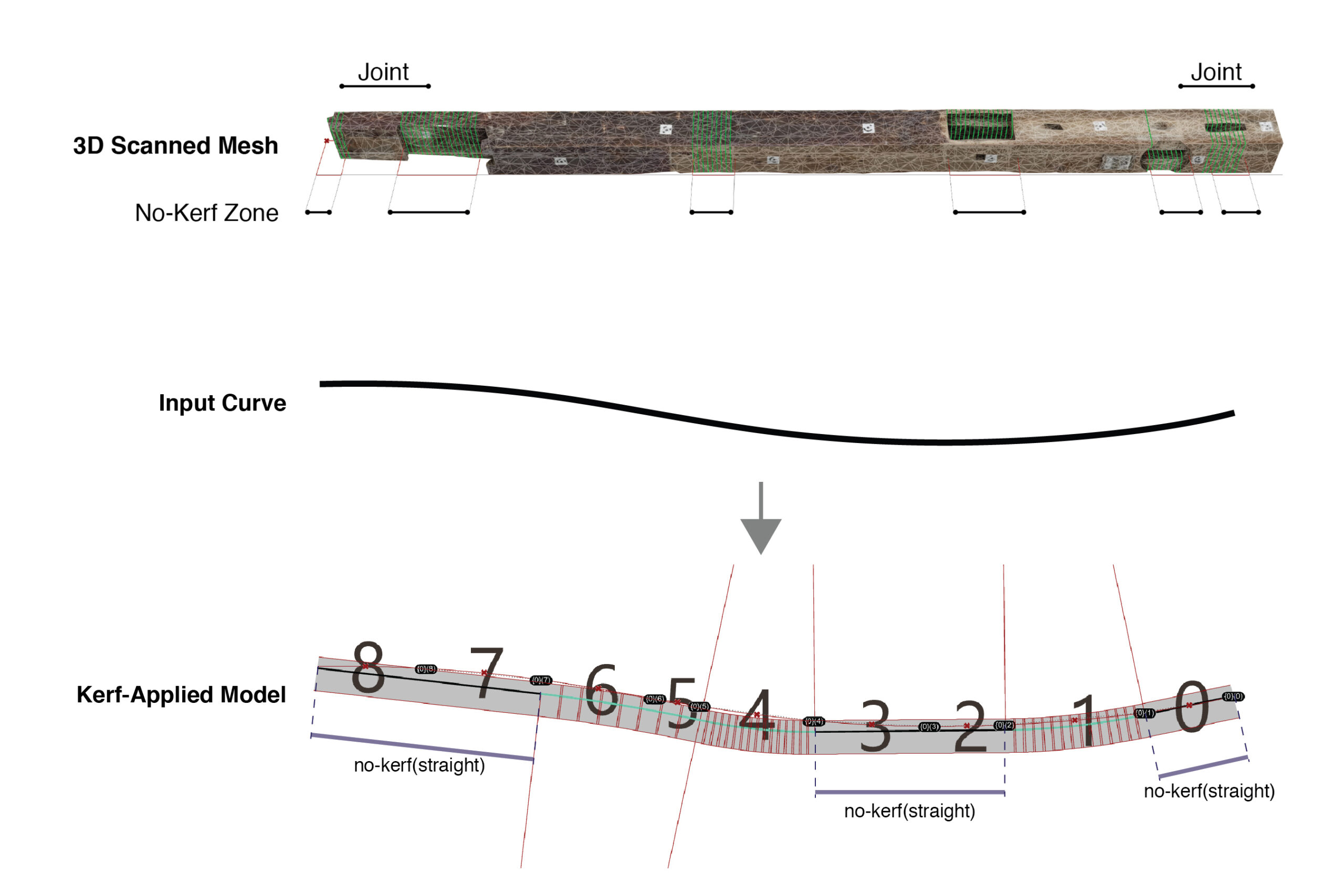
従来のカーフベンド研究はジオメトリの生成・制御に主眼があり、スリット配置の調整やくさび挿入による応力伝達といった構造性能の担保については十分に検討されてこなかった。本研究では、まずFEM解析上でターゲット形状の部材に生じる圧縮・引張領域を特定し、引張が生じる範囲にスリットを入れるのを避ける形でカーフベンドを行う手法を提示する。加えて、カーフベンドにより曲げた材を構造材として成立させるため、構造材として必要とされる接合部や、古材であれば古材特有の欠損部位へのスリット加工を避けながら、ターゲットとする形状に近い曲げを実現する。
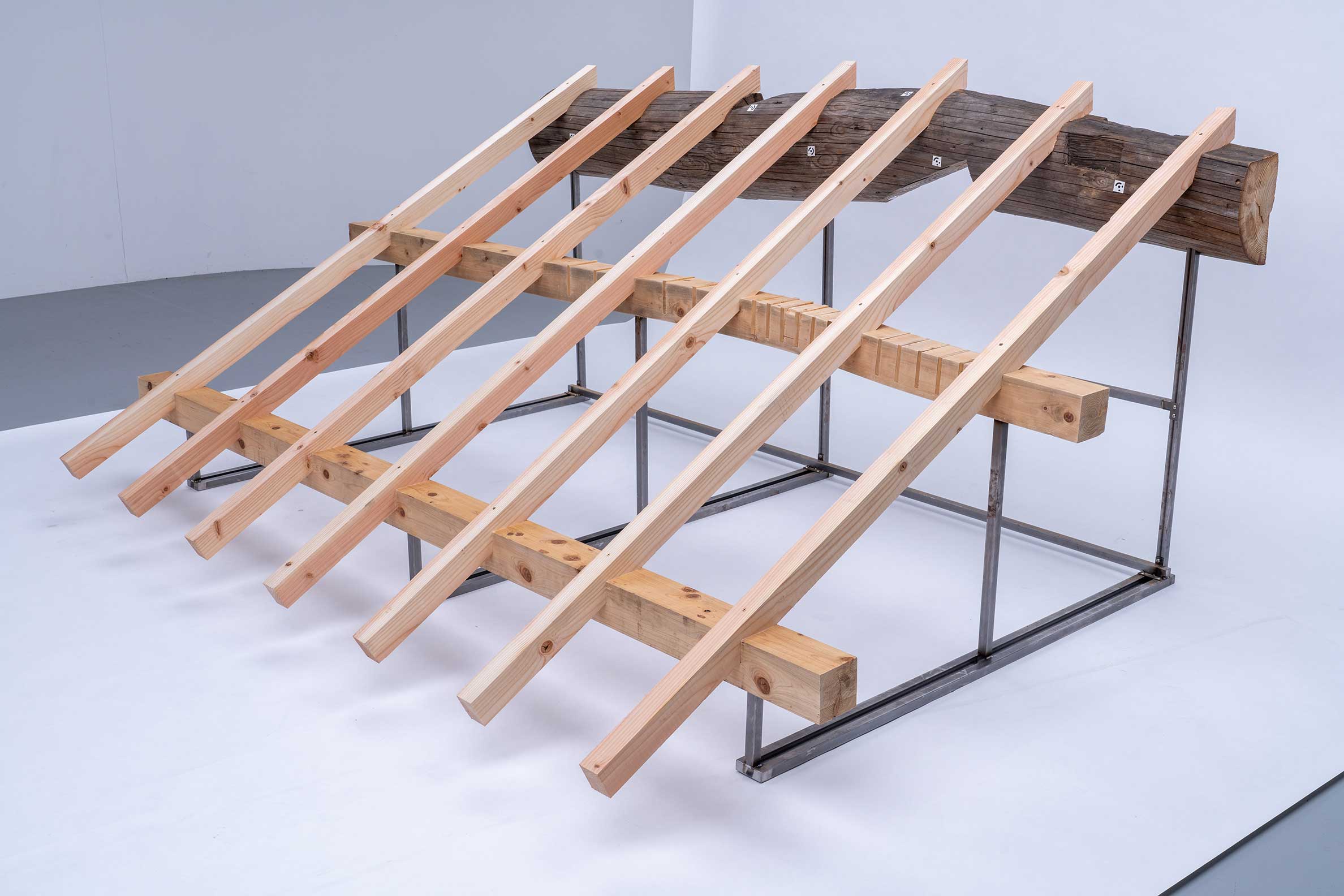
古材の使用に際しては3Dスキャンを併用し、形状を正確に把握しながら適材適所に加工を加える。実証実験としては小規模な屋根架構を想定したプロトタイプの試作を行った。曲げが必要な材には曲率とFEM解析結果を踏まえて最低限のスリットを配置し、曲げ後の最終形状と理想形状を比較したところ、設計段階のシミュレーションと実加工後の最終曲率が良好に一致した。また、亀裂発生や過度の割れなども最低限にとどめることができ、材料ロスや施工コストが抑えられる見通しが得られた。
これにより、湾曲した古材や欠損のある部材であっても、設計段階から構造的リスクを低減した形で活用できる可能性が示唆される。将来的には、3次元曲線を部材芯とする材への展開も期待され、木材資源の循環活用とデザインの多様化を推進する基盤となることが見込まれる。
The paper “Structurally Informed Kerf-Bending for Timber,” authored by Project Researcher Yo Tomura, Project Associate Professor Toshikatsu Kiuchi, Associate Professor Makoto Muramoto, and KIT students Taihei Mizutani and Kosei Matsushima, was awarded the Best Paper Runner-up at ACADIA 2025.
ACADIA (Association for Computer-Aided Design in Architecture) is an international network devoted to advancing computational design research and practice in architecture. The organization has held annual conferences across North America since its founding in 1981.
This paper proposes a design-to-fabrication method for timber kerf-bending. The method identifies high-risk regions of potential failure by analyzing tensile stress distributions generated during bending, and determines optimal kerf locations by avoiding defects and joints detected via 3D scanning. By integrating these structural and geometric considerations, the process ensures both structural integrity and geometric accuracy. This enables the kerf-bending of non-uniform or reclaimed timber containing knots, checks, or other irregularities.
Regeneration and Extension of Traditional Japanese Post-and-Beam Construction
Yo Tomura*1
[Project Researcher, KYOTO Design Lab, Kyoto Institute of Technology]
Toshikatsu Kiuchi*1
[Project Associate Professor, Center for the Possible Futures, Kyoto Institute of Technology]
Makoto Muramoto*2
[Associate Professor, Department of Architecture and Design, Kyoto Institute of Technology]
Taihei Mizutani
[Master’s student, Kyoto Institute of Technology]
Kosei Matsushima
[Master’s student, Kyoto Institute of Technology]
*1 First Authorship *1 Senior Authorship
Abstract
This study offers a design and fabrication approach to incorporate a mixture of uniform and non-uniform—bent reclaimed or naturally curved—timber into a structural system with the same ease as conventional straight lumbers. The proposed approach integrates kerf-bending techniques with finite element method (FEM) analysis to attain desired curvature with minimal loss of structural integrity.
Unlike previous kerf-bending work that focused on the creation of geometry, we address structural performance directly: we locate areas of tensile stress in the target bend and avoid cutting there, restricting kerf cuts to the compressive side of members. In addition, to enable the bent wood to serve as a true structural member, we avoid cutting at critical locations (i.e., joinery interfaces or damage zones in recycled beams) by leveraging 3D scanning to digitally capture each piece’s geometry and detect defects.
We demonstrate the process on a small roof prototype, with minimal kerf cutting guided by curvature analysis and FEM simulation. The kerf-bent beam achieved its final form very near the design model, and only minimal, non-critical cracking occurred—demonstrating that the technique can reduce material waste and fabrication costs.
The result demonstrates that even highly curved or defect-laden reclaimed members can be reused in new construction with significantly lower structural risk. In the future, it is possible to apply this method to members with full three-dimensional curvature and provide a basis for more effective circular use of wood resources and increased building design diversity.